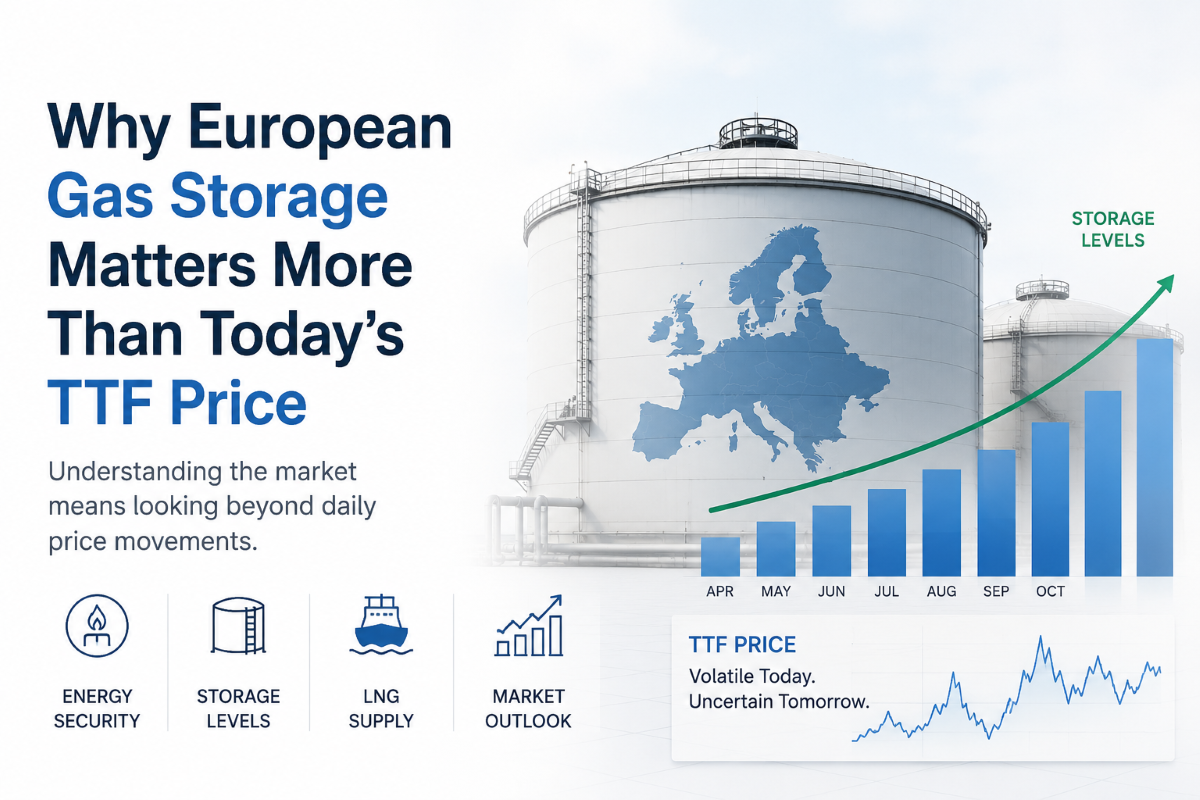
Every day, energy professionals watch the TTF gas price.
Financial media report every price move.
Analysts discuss daily volatility.
Traders monitor intraday charts.
Yet many market participants focus on the symptom rather than the cause.
While TTF remains Europe's most important natural gas benchmark, the real story often lies elsewhere.
In many cases, the most important indicator is not today's gas price.
It's the amount of gas stored beneath Europe.
Understanding European gas storage levels can provide deeper insight into future market conditions than simply watching daily price movements. For traders, analysts, procurement teams, utilities, and risk managers, storage often serves as the foundation upon which future prices are built.
Why Gas Storage Exists
Natural gas demand is highly seasonal.
Consumption typically increases during winter as households and businesses require heating. During summer, demand often declines, allowing countries to replenish inventories for the next heating season.
Gas storage acts as Europe's energy buffer.
When supplies are abundant, gas is injected into underground storage facilities. During periods of high demand or supply disruption, those reserves can be withdrawn to stabilize the market.
Without storage, Europe would be significantly more vulnerable to sudden supply shocks, weather events, infrastructure outages, and geopolitical disruptions.
Storage is not merely an operational tool.
It is one of the most important indicators of energy security.
The Market Watches Storage for a Reason
A common mistake is assuming that today's gas price reflects today's reality.
In practice, commodity markets are forward-looking.
Prices are often driven by expectations about future supply and demand conditions.
Gas storage levels provide one of the clearest signals about those future conditions.
When storage inventories are high heading into winter, market participants generally have greater confidence that demand can be met.
When storage levels are low, uncertainty rises.
The market begins pricing in the possibility of shortages, increased LNG competition, emergency purchases, or even demand destruction.
As a result, storage trends frequently influence prices long before any actual shortage occurs.
The Psychology of Energy Markets
Energy markets are driven by risk.
The same storage level can produce different market reactions depending on the broader environment.
Imagine Europe enters winter with storage at 90%.
Under normal circumstances, the market may view this as comfortable.
However, if geopolitical tensions are rising, LNG cargo availability is tightening, or weather forecasts suggest an unusually cold season, those same inventories may suddenly appear less adequate.
The opposite can also occur.
Storage levels may be below average, yet prices remain relatively stable because market participants expect strong LNG imports or mild weather conditions.
This is why professional traders rarely look at storage in isolation.
They view it within a broader risk framework that includes:
- Weather forecasts
- LNG flows
- Pipeline supplies
- Geopolitical developments
- Infrastructure outages
- Industrial demand trends
Storage is often the starting point of the analysis, not the conclusion.
Why Storage Matters More Than Daily Gas or LNG Price Moves
Daily price fluctuations often contain noise.
Prices can move because of:
- Short-term speculation
- Profit taking
- Technical trading
- Currency fluctuations
- Temporary news headlines
Storage trends, however, develop over weeks and months.
They provide a clearer picture of structural market conditions.
A single-day price spike may be forgotten within days.
A storage deficit entering winter can influence market behavior for an entire season.
This is why many institutional participants spend as much time analyzing inventory data as they do analyzing price charts.
They want to understand what may happen next rather than simply reacting to what happened today.
The LNG Connection
Europe's growing reliance on LNG has made storage even more important.
Following major changes in pipeline gas flows over recent years, LNG became a critical component of European supply security.
Storage and LNG now work together.
Strong LNG imports can help replenish inventories.
Weak LNG arrivals can slow storage injections and increase market concern.
This relationship has transformed Europe into a direct competitor with Asia for LNG cargoes.
When storage levels are low, Europe often needs to attract additional cargoes by offering higher prices.
When inventories are comfortable, that competition may ease.
As a result, traders increasingly monitor storage levels alongside LNG benchmarks such as JKM and regional shipping flows.
Storage Is Really a Risk Indicator
One of the most important shifts in energy markets over the past decade is the growing realization that storage is not simply a supply metric.
It is a risk metric.
Storage tells us how resilient the system may be under stress.
Higher inventories generally increase flexibility.
Lower inventories reduce flexibility and increase vulnerability.
The market is constantly assessing this balance.
Every storage update influences expectations about future supply adequacy and future price risk.
This is why storage data is often closely watched by:
- Energy traders
- Utilities
- Procurement managers
- Risk analysts
- Energy consultants
- Policymakers
Each group understands that inventories represent far more than physical gas.
They represent optionality, flexibility, and resilience.
Looking Beyond Today's Price
The next time TTF experiences a sharp move, it is worth asking a different question.
Instead of focusing solely on the price itself, consider what the market may be signaling about future risk.
Are storage levels rising or falling?
How quickly are inventories changing?
What does the trend suggest about the coming months?
Because while today's TTF price captures the market's current opinion, storage levels often reveal the conditions that may shape tomorrow's reality.
And in energy markets, understanding future risk is often more valuable than understanding today's price.
Final Thoughts
European gas storage remains one of the most important indicators for understanding energy markets.
It helps explain price behavior, supply security concerns, LNG demand, and seasonal risk.
For professionals seeking to move beyond headlines and gain a deeper understanding of market dynamics, storage data provides critical context that daily price movements alone cannot offer.
In a world increasingly shaped by uncertainty, resilience has become a valuable commodity.
And few indicators reveal resilience better than Europe's gas storage levels.