A Global Risk Index for a World Where Prices React Faster Than Reality
Markets move fast. Headlines move faster.
But systemic risk moves differently.
That's why we built GERI.
GERI (Global Energy Risk Index) is not a price, not a forecast, and not a headline feed. It is a daily risk regime signal that tells you whether global geopolitical and energy stress is building, peaking, or dissipating—before or after markets react.
Every day, markets shout: "Something is happening!"
But they don't answer the question that matters most:
Is this real systemic risk—or just short-term noise?
Prices react instantly.
Risk accumulates gradually.
Confusing the two leads to:
GERI was built to solve this gap.
GERI aggregates global geopolitical and energy stress signals into a single, interpretable daily score (0–100), updated every day.
How severe are current events?
Is risk spreading or localized?
Oil, gas, freight pressure
Not panic—structural stress
GERI doesn't chase markets.
It measures whether stress is becoming structural.
This is where GERI proves its value.
Oil prices react quickly to headlines and sentiment. GERI rises only when those moves are supported by sustained geopolitical or energy pressure.
If oil spikes but GERI stays stable: The market may be overreacting.
If oil pulls back but GERI remains elevated: Risk hasn't actually gone away.
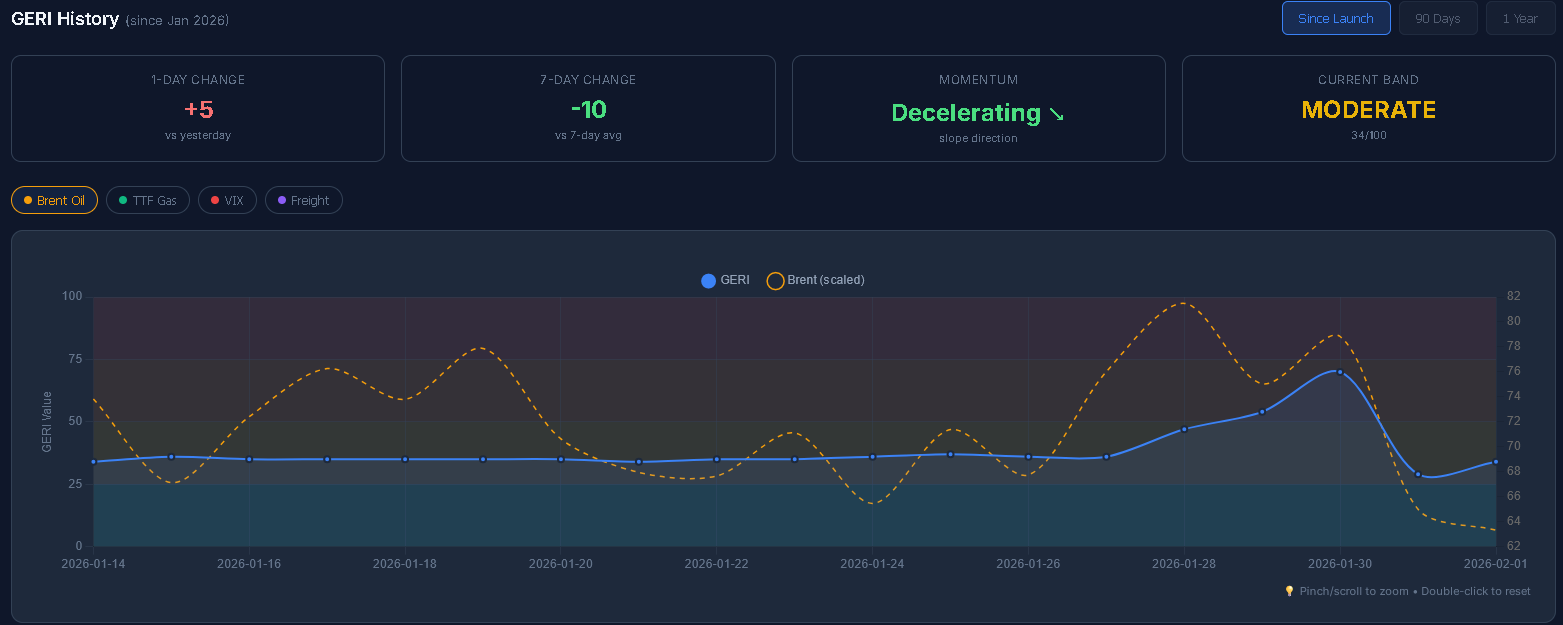
GERI (blue) vs Brent Oil (orange) - Notice how GERI moves more deliberately
European gas prices are volatile by nature. They reflect regional stress, infrastructure constraints, and short-term flows.
GERI filters this: Local panic stays local.
Only contagious, cross-regional risk moves the index.
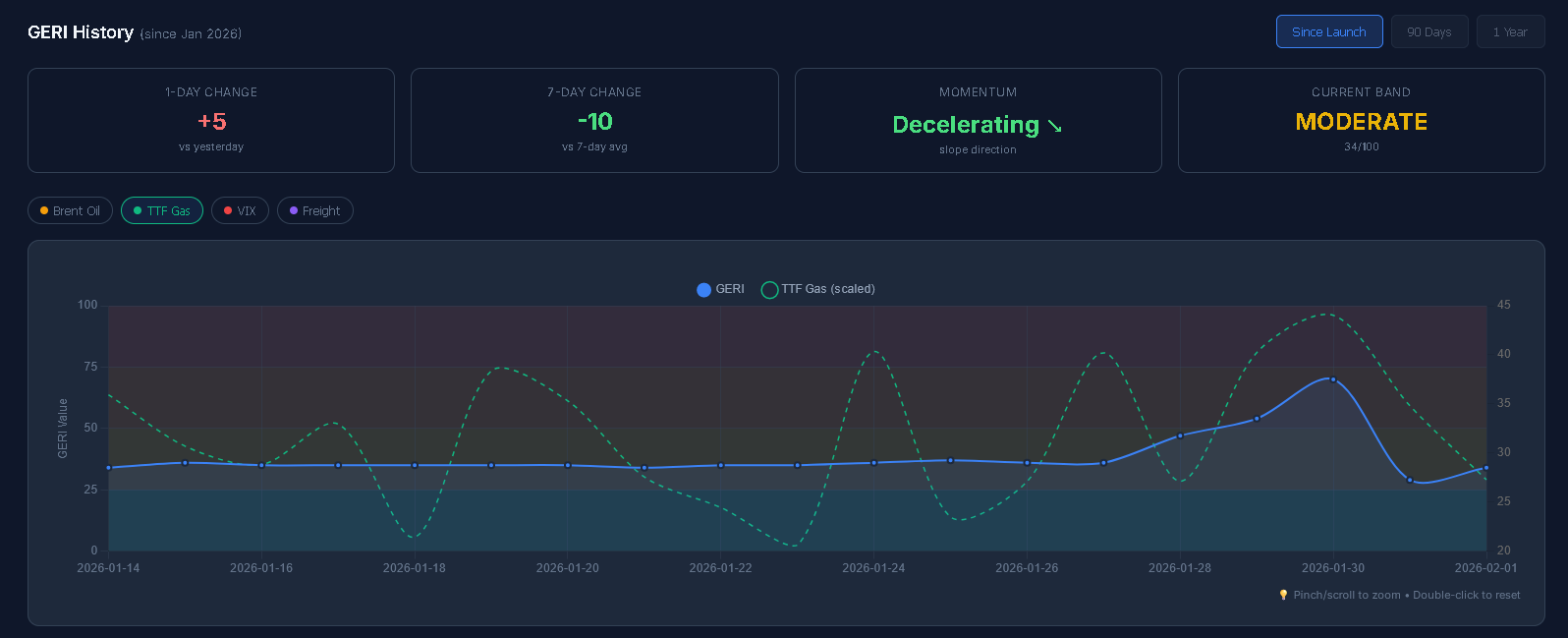
GERI (blue) vs TTF Gas (green) - Gas volatility filtered for global relevance
Volatility spikes fast—and collapses just as fast. GERI behaves differently: it rises more slowly, peaks later, and stays elevated longer.
This is intentional. GERI reflects structural pressure, not emotional market reactions.
It often remains elevated after volatility fades, when risks still exist but markets feel calm again. That's where most mistakes happen.
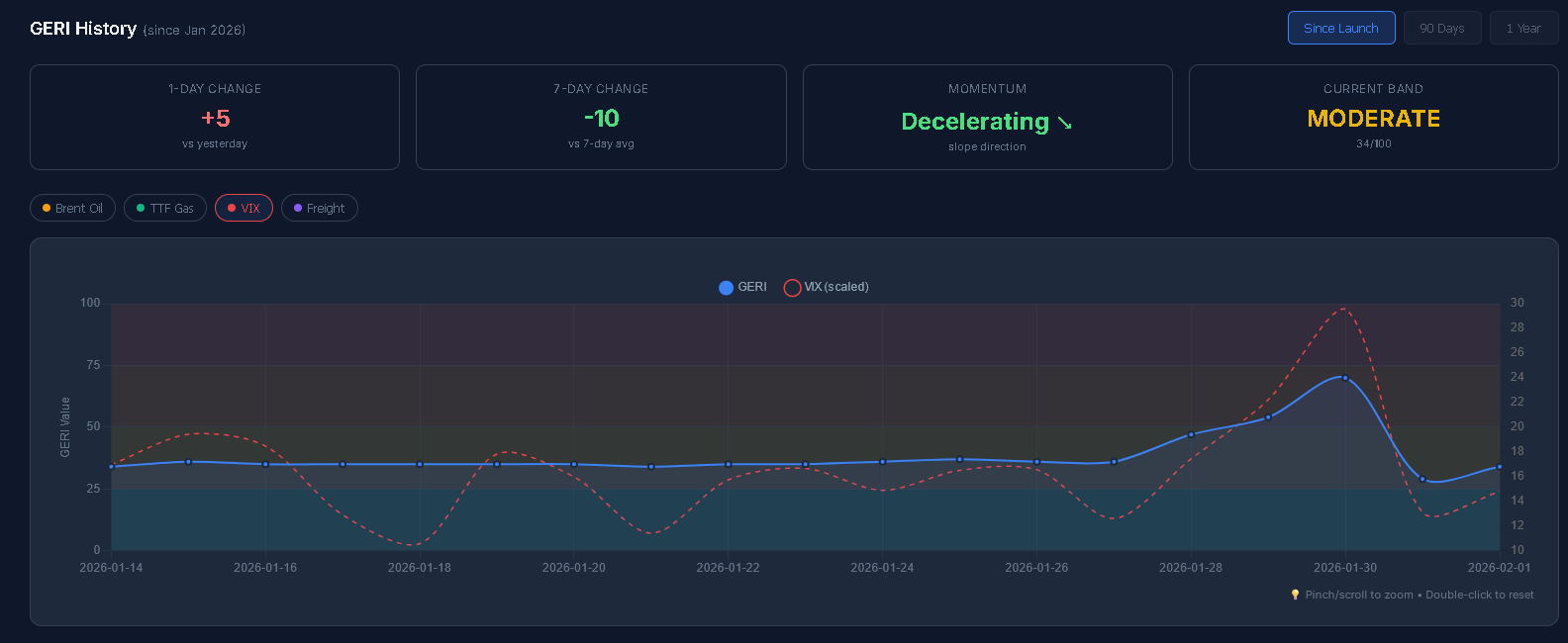
GERI (blue) vs VIX (red) - GERI stays elevated longer than volatility
Freight reacts instantly to disruption. GERI tells you whether that disruption is temporary or systemic.
Not every shipping shock becomes a global risk event.
GERI highlights the ones that do.
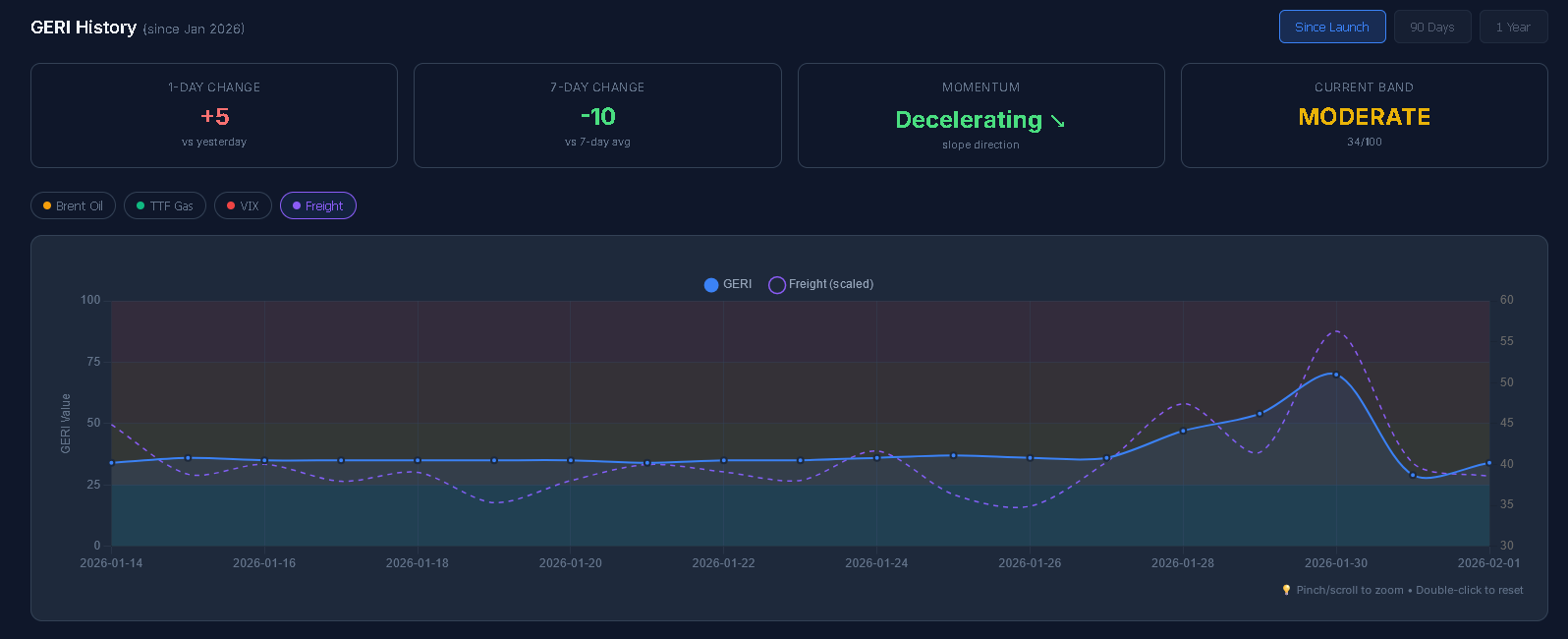
GERI (blue) vs Freight (purple) - Distinguishing noise from systemic disruption
Across oil, gas, volatility, and freight, one pattern repeats:
Markets react first. GERI moves later—but more reliably.
That makes GERI ideal for:
GERI doesn't compete with prices.
It puts them in context.
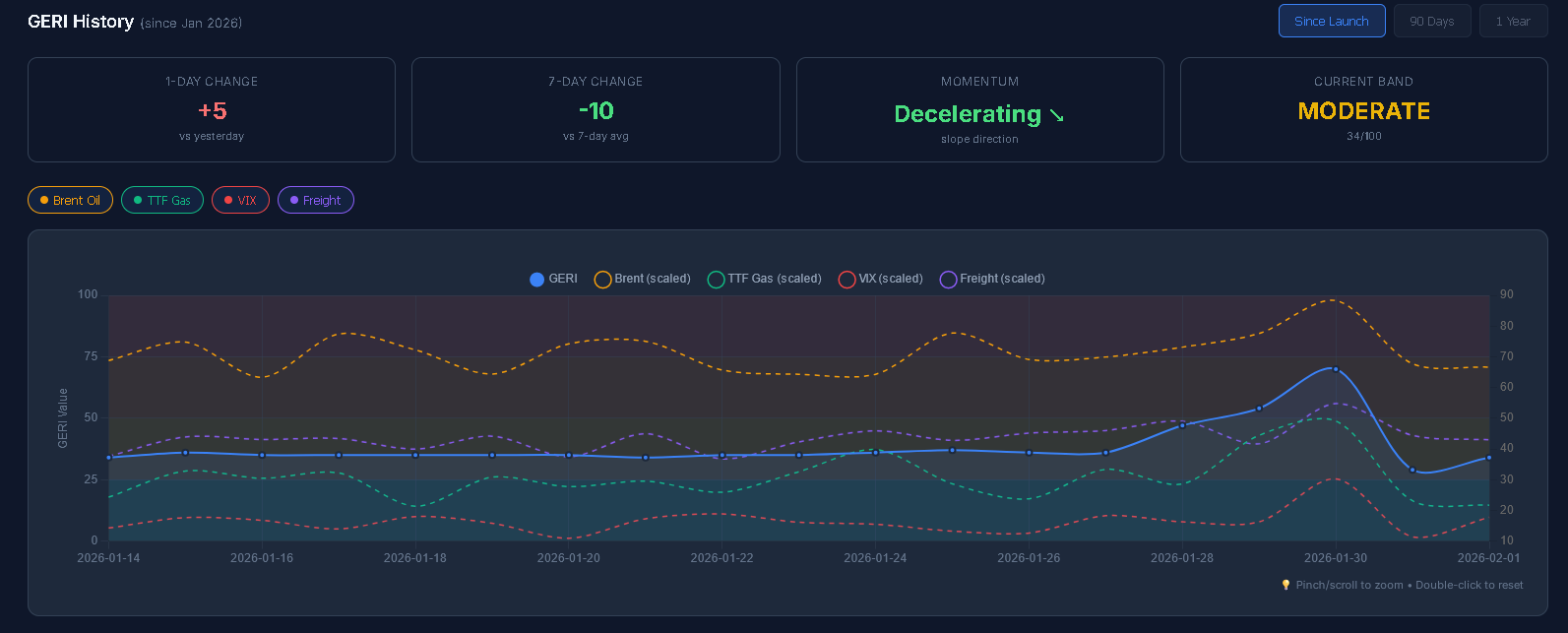
Pro subscribers unlock Live-GERI:
Live-GERI Dashboard: GERI with Oil, Gas, VIX, and Freight overlays
Updated daily as soon as the index is computed. Public users see it later. You don't.
Track how global risk evolves over time: rising, peaking, decelerating, stabilizing. No guessing. No memory bias.
Instantly see day-to-day change, 7-day trend, and acceleration vs deceleration. This turns GERI into a decision aid, not just a number.
See how GERI behaves relative to markets, not instead of them. This is where insight happens.
GERI translates complexity into regimes you can act on. No interpretation gymnastics required.
Live-GERI is used by people who need to answer questions like:
"Are we entering a higher-risk regime?"
"Is this move justified—or just loud?"
"Should we de-risk now, or wait?"
"Why did we take (or avoid) this position?"
To be clear, GERI is not:
It is something more useful:
A daily lens on global risk pressure.
GERI is still early in its lifecycle.
That's an advantage—not a weakness.
By subscribing now, you:
As history deepens, GERI becomes more powerful.
Early users benefit the most.
Markets will always move. Headlines will always shout.
GERI tells you whether the world is actually becoming more dangerous—or just noisier.
Unlock Live-GERI today and start monitoring risk regimes, not just prices.
Get Live-GERI Access →