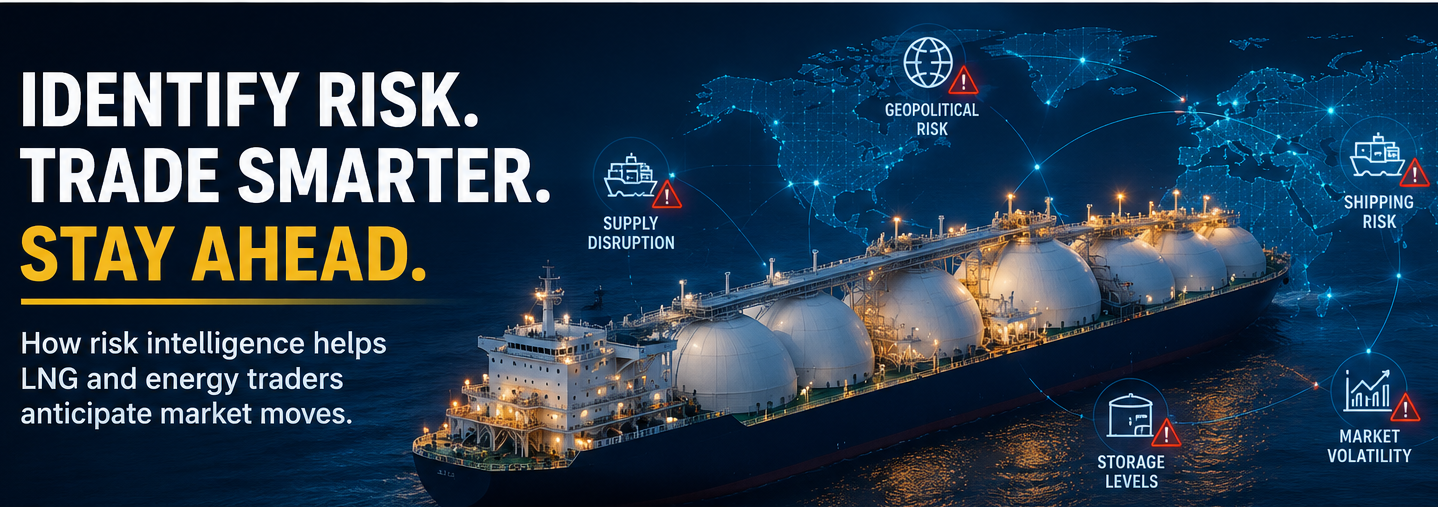
The Hidden Edge Most Energy Traders Miss
Most traders spend their days watching charts.
They track LNG prices, TTF futures, Brent crude, natural gas storage levels, shipping rates, and economic news. They analyze support and resistance, moving averages, and momentum indicators.
Yet many still find themselves reacting to markets instead of anticipating them.
Why?
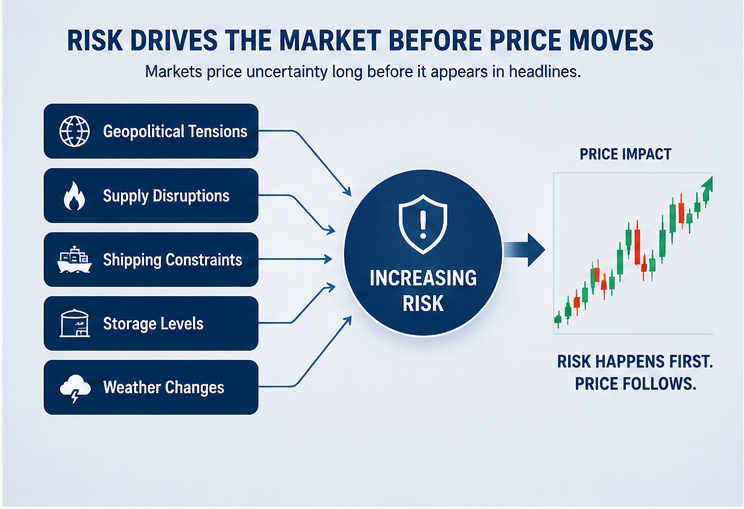
Because energy markets rarely move because of the news itself.
They move because of the risk behind the news.
And in today's increasingly interconnected energy system, understanding risk has become one of the most valuable trading advantages available.
LNG Markets Are Driven by Risk, Not Headlines
Consider how LNG markets behave.
When a major geopolitical event occurs, LNG prices don't necessarily react because the event happened.
Prices react because traders immediately begin evaluating:
- Will global supply be disrupted?
- Could shipping routes become unsafe?
- Will insurance costs increase?
- Are buyers likely to secure cargoes earlier?
- Will Europe need additional LNG imports?
- Could Asian demand suddenly intensify?
The market is constantly pricing future uncertainty.
By the time a headline reaches mainstream media, professional traders have often already started repositioning.
This is why risk identification is so important.
The earlier you identify risk, the earlier you can understand where prices may move next.
LNG Is No Longer an Isolated Market
A decade ago, regional gas markets behaved relatively independently.
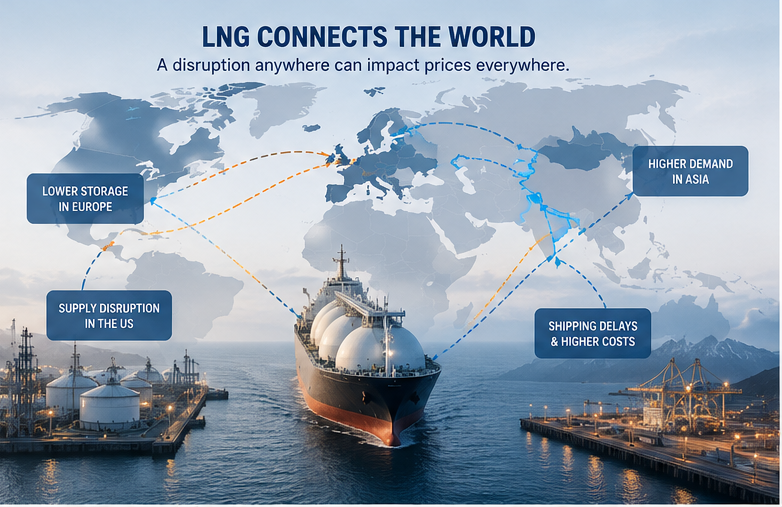
Today, LNG has connected energy markets across the globe.
A disruption in one region can rapidly impact prices thousands of miles away.
For example:
Europe vs Asia Competition
European buyers compete directly with Asian buyers for LNG cargoes.
If Asian demand rises unexpectedly, LNG shipments may be diverted away from Europe.
This can tighten European supply and influence TTF prices almost immediately.
Shipping Risks
Events affecting major maritime routes can alter LNG flows worldwide.
Longer routes mean:
- Higher transportation costs
- Increased shipping delays
- Greater vessel demand
- Reduced effective supply
The result is often increased market volatility.
Storage Risks
Storage levels provide valuable insight into future market vulnerability.
A region entering winter with lower-than-normal inventories becomes increasingly sensitive to:
- Cold weather
- Supply outages
- Infrastructure disruptions
- Unexpected demand spikes
The market frequently begins pricing these risks long before physical shortages appear.
Why Price Data Alone Is No Longer Enough
Many traders rely primarily on historical prices.
The problem is that prices tell you what has already happened.
Risk intelligence helps explain what may happen next.
Think of it this way:
Price charts show the outcome.
Risk signals show the potential causes before the outcome occurs.
When geopolitical tensions rise, energy infrastructure becomes threatened, shipping disruptions increase, or supply concerns emerge, traders who monitor risk can often identify changing market conditions earlier.
This does not guarantee market direction.
However, it provides additional context that pure technical analysis often misses.
How Risk Intelligence Can Improve LNG Trading Decisions
Professional traders increasingly combine traditional market analysis with risk monitoring.
This creates a more complete market picture.
For example:
Scenario 1: Rising LNG Prices
A trader sees LNG prices moving higher.
Without risk analysis, they only know prices are increasing.
With risk intelligence, they may discover:
- Escalating geopolitical tensions
- Increased supply disruption alerts
- Growing shipping constraints
- Falling storage inventories
The move becomes easier to understand.
Scenario 2: Falling LNG Prices
Prices begin declining.
Risk monitoring may reveal:
- Reduced geopolitical tensions
- Improving storage conditions
- Increased LNG supply availability
- Lower probability of disruptions
Again, the trader gains context rather than simply observing price movement.
The EnergyRiskIQ Approach
At EnergyRiskIQ, our goal is simple:
Help traders identify developing risks before they become obvious market narratives.
Rather than focusing solely on prices, we monitor indicators that can influence energy markets, including:
- Global energy risk conditions
- European energy risk developments
- Supply disruption signals
- Geopolitical escalation trends
- Storage dynamics
- Cross-market energy relationships
These insights help traders understand not only where prices are today, but why markets may be changing.
Whether you're trading:
- LNG
- TTF Natural Gas
- Brent Crude Oil
- WTI Crude Oil
- Energy Equities
- Energy ETFs
Understanding risk can provide a valuable additional layer of market intelligence.
The Future of Energy Trading
Energy markets are becoming more complex every year.
A single event can influence:
- LNG prices
- Natural gas futures
- Oil benchmarks
- Power markets
- Shipping rates
- Currency markets
The traders who thrive in this environment will not simply react to prices.
They will focus on understanding risk.
Because in modern energy markets, risk often moves first.
Price simply follows.
Discussion
I'm curious:
When you trade LNG, natural gas, oil, or other energy assets, what do you consider the most important risk factor?
- Geopolitics?
- Supply disruptions?
- Storage levels?
- Weather?
- Shipping constraints?
- Something else entirely?
Share your thoughts in the comments. The most valuable market insights often come from different perspectives.