Every day, millions of traders, analysts, procurement managers, and investors ask the same question:
"Where will Brent oil prices go next?"
The challenge is that Brent crude doesn't move because of a single headline. Oil prices are influenced by dozens of interconnected economic, geopolitical, financial, and physical market forces.
Understanding these drivers can help you anticipate market movements before they appear in the price chart.
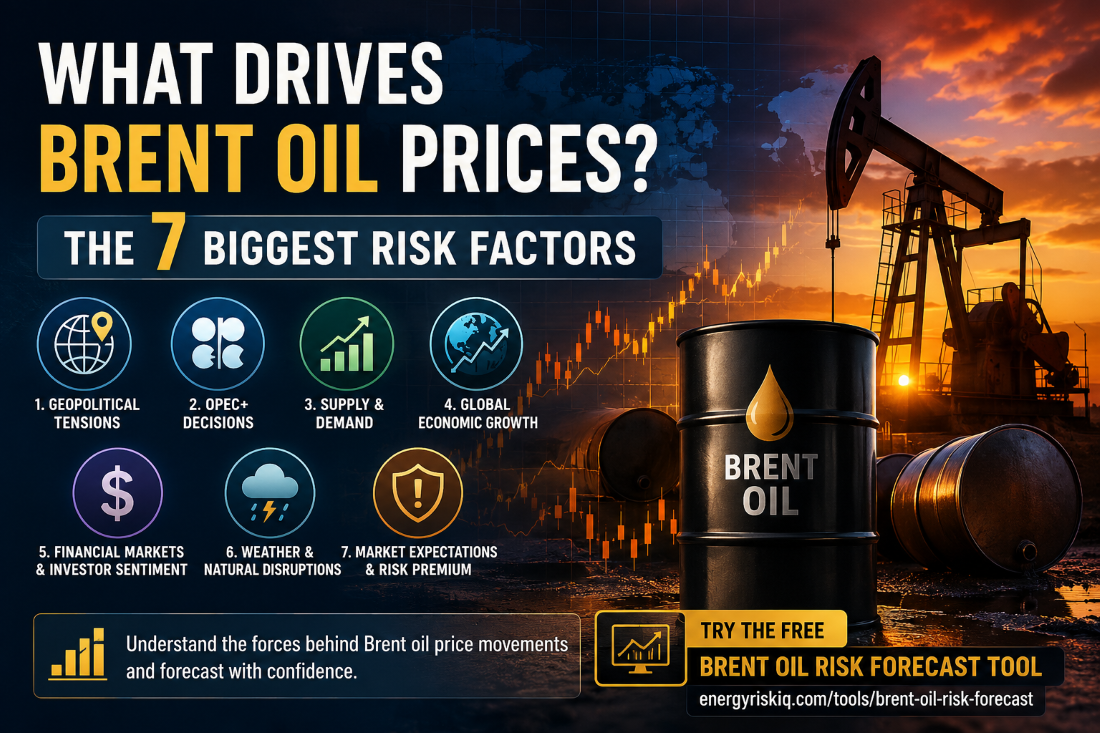
In this guide, we'll explore the seven biggest risk factors that influence Brent crude oil prices -- and show you how you can evaluate their combined impact using our free Brent Oil Risk Forecast Tool.
1. Geopolitical Tensions
If there is one factor capable of moving Brent prices within minutes, it is geopolitical risk.
Markets closely monitor developments such as:
- Military conflicts
- Terrorist attacks
- Sanctions
- Political instability
- Shipping disruptions
- Pipeline attacks
Why?
Because roughly one-third of globally traded crude oil moves through strategic chokepoints like the Strait of Hormuz, making any disruption a potential threat to global supply. Even the possibility of reduced supply can cause traders to build a geopolitical risk premium into oil prices.
Recent history has shown how tensions in the Middle East can trigger sharp intraday swings in Brent prices, even before physical production is affected.
2. OPEC+ Production Decisions
Few organizations influence oil markets more than OPEC+.
When the group announces:
- production cuts,
- production increases,
- voluntary export reductions,
- quota changes,
the market immediately reassesses future supply.
A surprise production cut often pushes Brent higher.
An unexpected increase in production usually pressures prices lower.
However, markets also consider whether member countries are actually complying with announced quotas—not just the headlines.
3. Global Supply and Demand
At its core, Brent is still governed by basic economics:
Supply vs. Demand.
Prices generally rise when:
- global demand grows faster than supply,
- inventories decline,
- refinery demand increases.
Prices often weaken when:
- economic activity slows,
- inventories build,
- production exceeds consumption.
The U.S. Energy Information Administration (EIA) identifies the global supply-demand balance and petroleum inventories as fundamental drivers of crude oil prices.
4. Global Economic Growth

Oil demand is directly linked to economic activity.
Growing economies consume more:
- diesel,
- jet fuel,
- gasoline,
- petrochemical feedstocks.
China, the United States, India, and Europe are among the world's largest consumers of crude oil.
When manufacturing expands, airlines increase flights, and freight volumes rise, oil demand typically follows.
Conversely, recession fears often weigh on Brent prices as traders anticipate weaker future consumption.
5. Financial Markets and Investor Sentiment
Oil is not only a physical commodity—it is also one of the world's largest financial markets.
Every day, hedge funds, banks, commodity trading advisors, and institutional investors trade Brent futures.
Their positioning can amplify price movements beyond what physical supply and demand alone would suggest.
Examples include:
- increased speculative buying,
- short covering,
- risk-off selling,
- macroeconomic uncertainty.
The EIA and the European Central Bank both highlight financial positioning as an important contributor to oil price volatility, particularly when inventories or supply-demand balances are already tight.
6. Weather and Natural Disruptions
Weather affects both oil production and consumption.
Examples include:
- hurricanes in the Gulf of Mexico,
- severe winter storms,
- refinery outages,
- flooding,
- extreme heat increasing power demand.
These events can temporarily disrupt production, transportation, refining, or storage, creating short-term price volatility.
Although weather-driven price spikes are often temporary, they can become significant when global supply is already constrained.
7. Market Expectations and Risk Premium
Perhaps the least understood driver is expectation.
Oil markets don't wait for supply disruptions to happen.
They price the probability that they could happen.
This additional value embedded in Brent is known as the geopolitical risk premium.
For example:
- a threatened shipping route,
- rumors of sanctions,
- escalating military rhetoric,
may all lift prices before a single barrel of oil is actually lost.
Likewise, improving diplomatic relations can quickly remove this premium, causing prices to fall even if physical production hasn't changed.
This is why Brent often reacts to headlines long before official supply statistics are released.
Why Brent Oil Forecasting Is So Difficult
No single indicator explains Brent prices.
Successful forecasting requires understanding how multiple variables interact simultaneously.
For example:
- rising geopolitical risk,
- tightening inventories,
- falling spare production capacity,
- improving global demand,
together create a much stronger bullish signal than any one factor alone.
Likewise:
- recession fears,
- rising inventories,
- stronger production,
- lower geopolitical tensions,
can combine to pressure prices lower.
Professional analysts therefore monitor dozens of market indicators instead of relying on one news story or one technical chart.
Use Our Free Brent Oil Risk Forecast Tool
Instead of trying to manually evaluate every market variable, you can simulate different scenarios using the free Brent Oil Risk Forecast Tool available on EnergyRiskIQ.
The tool allows you to explore how changes in key market drivers may influence Brent prices under different conditions, making it useful for traders, analysts, procurement teams, students, and anyone interested in understanding oil market dynamics.
You can experiment with different geopolitical and market-risk scenarios in just a few seconds:
👉 https://energyriskiq.com/tools/brent-oil-risk-forecast
Whether you're asking:
- Will Brent oil rise next week?
- How could geopolitical tensions affect oil prices?
- What happens if OPEC cuts production again?
the tool provides a structured way to think through possible outcomes before markets move.
Final Thoughts
Brent crude oil prices are shaped by far more than daily news headlines.
Geopolitical events, OPEC+ decisions, global demand, inventories, financial markets, weather disruptions, and investor expectations all interact to create the price you see on your screen.
While no forecast can predict the future with certainty, understanding these seven major risk factors puts you in a much stronger position to interpret market movements—and to prepare for what may come next.
If you want to explore how changing market conditions could influence Brent prices, try the free Brent Oil Risk Forecast Tool and build your own scenarios based on today's energy market risks.